Taoism – The ancient Chinese philosophy has been offering practical insights into living well for over two thousand years. Rather than prescribing rigid rules, it encourages us to observe nature and learn from its rhythms. Taoism’s ideas about balance, flexibility and working with, rather than against, life’s inevitable changes make it relevant to many of the challenges in our daily lives.
If it matters, Hang On
Most of us have been told that if something matters, we should hold on to it. Our goals, our relationships, our beliefs, even our worries can become things we grip tightly. Yet the harder we hold on, the more exhausted we often become.
Taoism offers a different perspective.
Rather than asking whether we should hold on or let go, it asks whether our grip fits the situation. There is a world of difference between commitment and clinging.
The Taoist idea of wu wei, often translated as “effortless action” or “non-forcing”, isn’t about doing nothing. It is about responding to life without creating unnecessary struggle. An experienced sailor doesn’t fight the wind; they work with it. They remain alert and responsive; their actions are guided by what is happening as it happens, not by some predetermined set of rules or actions.
In short, sailing is about responding to conditions, not trying to control them.
Go with the Flow
This is where the familiar expression ‘going with the flow’ has its roots, though it is often misunderstood. It doesn’t mean drifting aimlessly or accepting whatever happens without question.
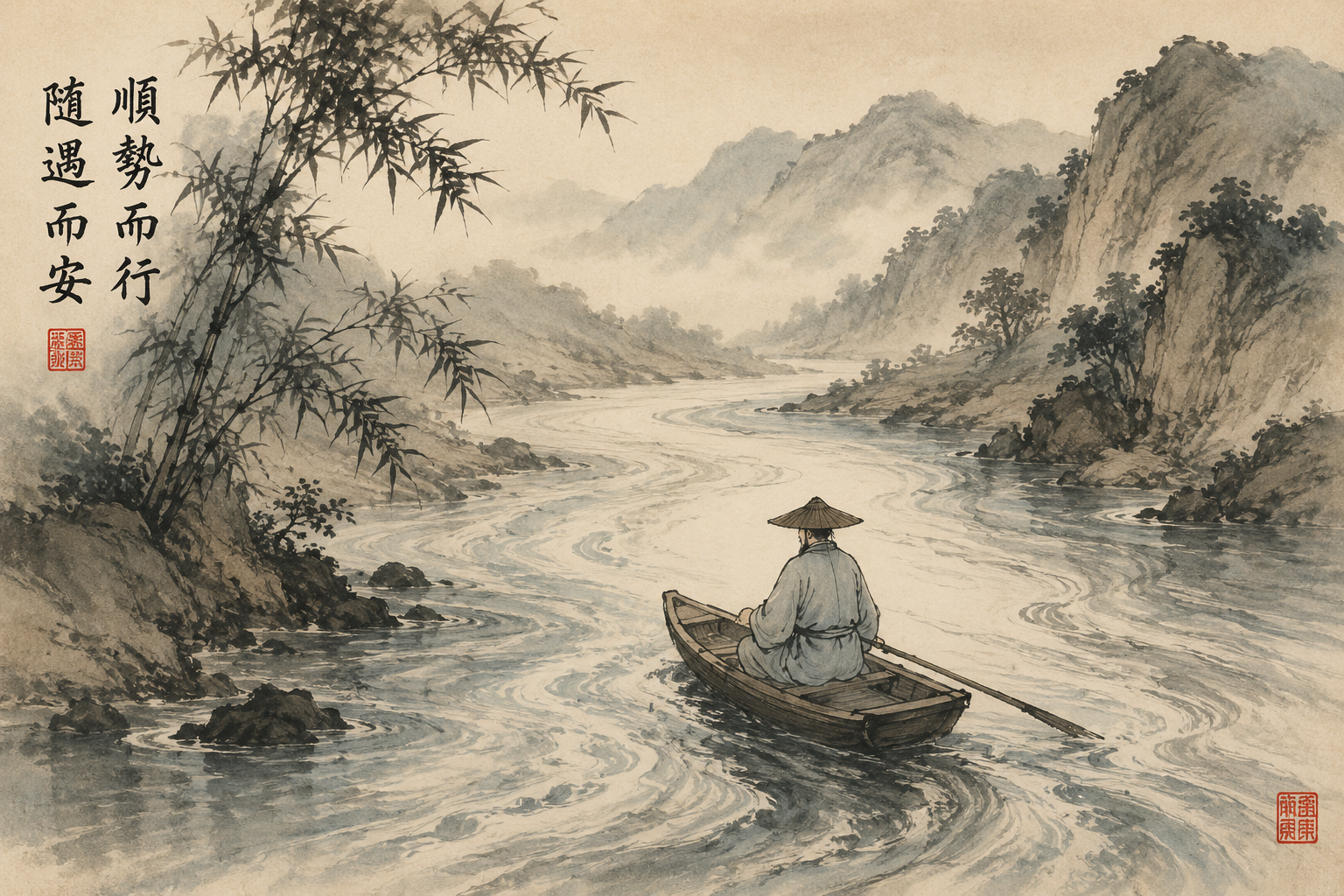
It means recognising that life is constantly changing and learning to respond to those changes rather than resisting them. Like a skilled kayaker reading the current, we can work with circumstances instead of wasting energy battling forces beyond our control. Going with the flow is an active choice to be flexible, attentive and responsive.
This is relevant in everyday life. We may hold on to an argument because we want to be right, a relationship because it feels safe, or an idea of ourselves that no longer serves us. Sometimes these things deserve our commitment. Sometimes they just weigh us down.
Recognising the difference.
This is the challenge, but it needn’t be. As a psychologist, I’ve noticed that many problems persist because people keep trying harder with strategies that no longer help. The solution is not always more of the same. Sometimes it is to loosen our grip, step back, and allow a different response to emerge. Maybe, even, we need to do a 180° turn.
One of the underlying tenets of Solution-Focused thinking is “If it’s not working, do something different”.
It always amazes me how a small shift in thinking can trigger a much bigger shift in outlook. Even something as slight as opening the mind to the possibility that there might be another way, allows us to become more flexible.
We can see reminders all around us in Nature. Trees that don’t bend in a storm are more likely to break than those that sway with the wind. Birds don’t struggle against the gale; they use the air currents to carry them along. Flexibility is one of the cornerstones of resilience.
Knowing when to be still, to observe, and go with the flow if you have to, means you can save your energy for a time when it will be more productive.
Instead of burning out as you struggle to hold on, you’ll find letting go can bring a delicious freedom.
Try it; you could find that easing your grip creates space for something better to take its place.
Discover more from Barry Winbolt
Subscribe to get the latest posts sent to your email.




More Posts






Discover more from Barry Winbolt
Subscribe to get the latest posts sent to your email.